Greece Golden Visa · 2026
One threshold,
three rights.
The Golden Visa — officially the investor residence permit — is a five-year, renewable residence permit for non-EU nationals who make a qualifying investment in Greece.
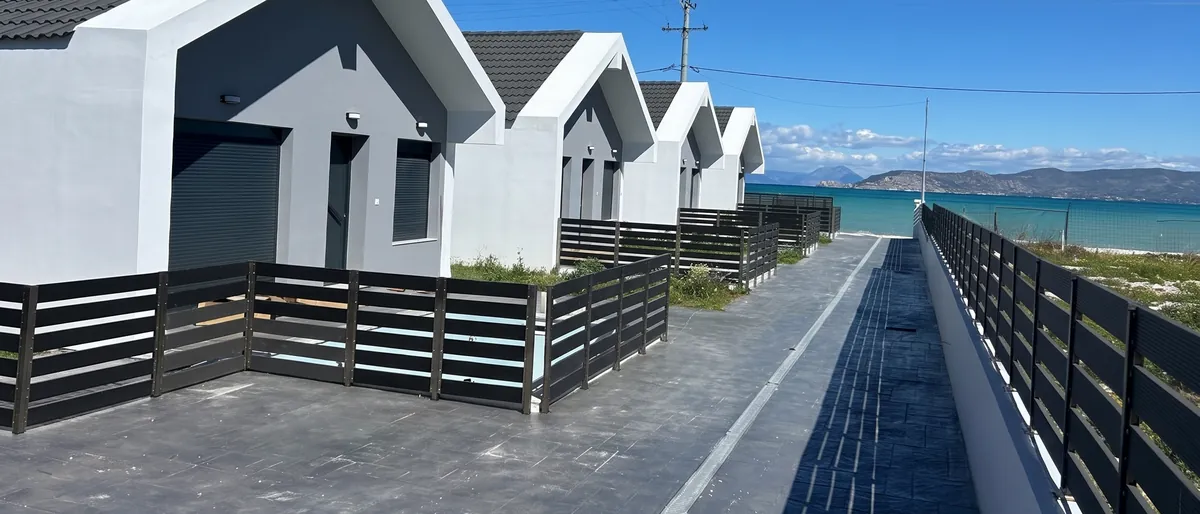
Cape Poseidon sits at the € 400,000 tier: the Gulf of Corinth lies outside the high-demand zones, and every villa on the project clears the 120 m² minimum area rule.
The key facts, in one place
- Threshold in the Gulf of Corinth: € 400,000 — the standard residential purchase route outside Attica, Thessaloniki, Mykonos, Thira and islands above 3,100 inhabitants.
- One single property, at least 120 m² — both conditions apply to the € 400,000 and € 800,000 tiers. Cape Poseidon: 120 m² (Villas 1–4) and 150 m² (Villa 5).
- Five-year permit, renewable indefinitely — provided the qualifying investment is maintained. Official permit fee: € 2,000.
- Family included with no extra investment — spouse or registered partner, dependent children up to 21 (to 24 in full-time tertiary education), and the dependent parents of both spouses.
- No minimum stay. The permit is not lost by living abroad.
- No right to employment. “Investor residence permits do not establish a right of access to any form of employment.”
- Schengen short stays on visa-waiver conditions, for every family member covered.
- Long-term letting permitted, short-term rental banned since the 2024 reform.
Thresholds
Where you buy
decides everything.
The 2024 reform replaced a single national threshold with a geographic one.
Article 64 of Law 5100/2024, which amended Article 100 of the Greek Migration Code (Law 5038/2023), set three tiers in force from 1 September 2024. The transitional window that allowed older applications to keep the former rules closed on 28 February 2025 — so every application filed since then faces the full thresholds below.
High-demand zones
The Region of Attica, the Regional Unit of Thessaloniki, the Regional Units of Mykonos and Thira, and all islands with more than 3,100 inhabitants.
- Single residential property
- At least 120 m² of main areas
Everywhere else in Greece
All remaining regions — mainland, provincial towns, the smaller islands. This is the tier that applies to Cape Poseidon.
- Single residential property
- At least 120 m² of main areas
Two specific routes only
Conversion of a commercial property to residential use, anywhere in Greece — and restoration of a listed or protected building, regardless of location.
- No 120 m² area requirement
- Works must be completed before applying
Why this project qualifies
Four conditions.
All met.
Cape Poseidon is eligible for review against the programme’s current criteria.
The right zone
Cape Poseidon lies on the southern shore of the Gulf of Corinth, outside Attica, the Thessaloniki Regional Unit, Mykonos, Thira and the islands above 3,100 inhabitants. The applicable threshold is therefore € 400,000, not € 800,000.
A single property
Each villa is acquired outright, in its own name. The current rules forbid splitting the investment across several smaller units — one property, one permit.
At least 120 m²
Villas 1 to 4 measure 120 m² of main areas; Villa 5 measures 150 m². Auxiliary storage and parking spaces do not count towards the area — and are not needed, since every unit already clears the threshold on its main areas alone.
Residential use
The villas are residential property acquired from the developer, not a commercial unit awaiting conversion. A residential acquisition of this size is the standard qualifying route.
Each purchase is eligible for review against the programme’s current criteria. Eligibility is assessed case by case by the competent authorities. Athestate acts as a real-estate advisor and does not provide immigration, legal or tax advice.
What the permit gives you
Three rights,
one condition.
The condition is simple, and it is the whole of the programme: keep the qualifying investment.
Residence permit
A five-year residence permit, renewable for successive five-year periods, issued to the holder, their spouse and dependent children.
- No minimum stay in Greece
- Each family member holds an individual permit card
- Official fee: € 2,000
Free movement
Visa-free short stays across the Schengen member states, on the conditions applied by each state.
- Applies to every family member covered
- Subject to the temporary internal-border measures some states applied from 2024
An ordinary Greek asset
Full ownership by Greek title deed, held in individual names. The permit imposes no restriction on the asset itself.
- Freely sold, mortgaged or inherited as ordinary Greek property
- Long-term letting permitted
The process
From first call
to permit card.
Allow four to six months from application to permit issuance. We run the steps in parallel wherever the law allows.
Selection & site visit
Allocation is by application, in order of registration, following a private visit on site — in person or remotely by live video.
Notarial transfer
Reservation, technical and legal due diligence, then the notarial deed and registration at the Land Registry. Payment flows through a Greek bank account.
AFM & bank account
Greek tax number (AFM), a Greek bank account and the E9 property declaration — all prerequisites for the application file.
Application & permit
File submitted through the Ministry of Migration and Asylum’s e-services, followed by biometrics and card issuance for the investor and each family member.
The numbers
What it really
costs.
The price of the villa is only the starting line. These are the costs a Greek buyer actually budgets for.
All figures below are indicative market ranges. Confirm them with your notary and an independent tax adviser before you commit — they depend on the taxable value of the property and the buyer’s circumstances.
Residence permit and tax residence are independent. The Golden Visa gives you the right to reside; it does not by itself make you a Greek tax resident, and it does not automatically place you in the 7% flat-rate regime for foreign income. If you are considering moving your tax residence too, that is a separate structuring conversation with your own adviser.
Frequently asked questions
Everything
worth asking.
Fifteen questions, answered from the current published rules.
Legal basis: Article 100 of the Greek Migration Code (Law 5038/2023), as amended by Article 64 of Law 5100/2024, Law 5275/2026, Joint Ministerial Decision 214926/2025 and Circular 1/2026 of the Ministry of Migration and Asylum. Figures reflect the programme’s published conditions as at September 2026 and may change.
How much do I need to invest for the Greek Golden Visa in 2026?
€ 800,000 in high-demand zones, € 400,000 everywhere else. For a standard residential purchase the thresholds are: € 800,000 in the Region of Attica, the Regional Unit of Thessaloniki, the Regional Units of Mykonos and Thira, and islands with more than 3,100 inhabitants; and € 400,000 in all other regions of Greece. A reduced € 250,000 threshold survives only for two specific routes — commercial-to-residential conversion and restoration of a listed or protected building — anywhere in the country.
Source: Article 100 of Law 5038/2023 as amended by Article 64 of Law 5100/2024 (in force 1 September 2024); Hellenic Ministry of Migration and Asylum.
Why does Cape Poseidon qualify at the € 400,000 threshold?
Because the € 800,000 tier applies only to the listed high-demand zones, and Cape Poseidon, on the southern shore of the Gulf of Corinth, lies outside them. The € 400,000 threshold therefore applies. On top of that, every villa at Cape Poseidon clears the 120 m² minimum area rule — Villas 1 to 4 measure 120 m² of main areas and Villa 5 measures 150 m² — and each is acquired as a single residential property, which is what the rules require.
Source: Hellenic Ministry of Migration and Asylum; project specification. Eligibility is assessed case by case by the competent authorities.
Must I buy one single property, and does it have to be at least 120 m²?
Yes to both, for the € 400,000 and € 800,000 tiers. The investment must concern one single property — you can no longer aggregate several smaller units to reach the threshold — and for built property, or property with a building permit, the main areas must measure at least 120 m². Storage areas and parking spaces do not count towards the area requirement, although their value may count towards the investment amount if acquired under the same deed as ancillary spaces. The 120 m² rule does not apply to the € 250,000 change-of-use route.
Source: Hellenic Ministry of Migration and Asylum (mitos.gov.gr), Golden Visa procedure pages; Circular 1/2026.
How long is the residence permit, and can it be renewed?
Five years, renewable for successive five-year periods as long as the qualifying investment is maintained. The official fee for the residence permit is € 2,000. The permit is granted to the investor personally on the basis of the qualifying investment, and the investment must be maintained for its duration. The 2025 documentation rules also make the investor’s E9 property declaration a mandatory supporting document, and the notarial certificate must confirm the 120 m² of main areas.
Source: Hellenic Ministry of Migration and Asylum; Joint Ministerial Decision 214926/2025 (11 November 2025).
Which family members are covered?
The permit extends, with no additional investment, to the spouse or registered partner, to unmarried dependent children up to the age of 21 — extended to 24 where the child is in full-time tertiary education — and to the dependent parents of both the investor and the spouse. Each family member receives an individual five-year permit card. Family members derive their residence rights from the sponsoring investor and can also be added later during the permit’s validity by submitting the supporting documents and paying the applicable fee.
Source: Circular 1/2026 of the Ministry of Migration and Asylum (22 April 2026); Ministry procedure documentation.
Do I have to live in Greece to keep the permit?
No. There is no minimum stay requirement. The permit is not lost through non-residence alone. What matters at each renewal is that the qualifying investment is maintained, that the property is retained, insured and compliant, and that the family status is unchanged.
Source: Ministry of Migration and Asylum guidance; consistent across legal commentary on the programme.
Can I work in Greece while holding the permit?
No. The Ministry of Migration and Asylum states it plainly: “Investor residence permits do not establish a right of access to any form of employment.” Holders may still own property, receive rental income, and hold shares in or act as a director of a Greek company, subject to Greek corporate and tax rules. Taking salaried employment in Greece would require a separate work permit.
Source: Hellenic Ministry of Migration and Asylum, e-services procedure pages.
Can I travel within the Schengen Area?
Yes — on visa-waiver conditions for short stays across the Schengen member states, for the investor and every family member covered by the permit. Travel rights remain subject to the temporary internal-border controls that some states applied from 2024 and can still apply, and they do not extend to employment or residence in another member state.
Source: Hellenic Ministry of Migration and Asylum; national Schengen border-control measures.
Can I rent the villa out?
Long-term rental is permitted under Greek tenancy law. Short-term rental is not: since the 2024 reform, properties acquired under the programme may not be let through short-term rental platforms such as Airbnb. The authorities have indicated that a breach can bring a fine and the risk of revocation of the residence permit.
Source: Law 5100/2024 and subsequent Ministry guidance; reported enforcement position.
What does the purchase cost besides the price of the villa?
Budget for the transfer tax (FMA), typically 3% of the taxable value plus a 3% municipal levy on the main tax, payable to AADE at the notarial deed; notary fees of roughly 0.5–1.5% plus VAT; cadastre and land-registry fees of about 0.5%; legal fees; and the real estate agent’s commission. Every year, as owner, you also pay ENFIA, the Greek property tax, calculated on the objective value, the zone, the surface and the year of construction.
Source: AADE; Athestate advisory. Indicative ranges — confirm with your notary and tax adviser.
How long does the whole process take?
Typically four to six months from application to permit issuance, depending on the workload of the competent authority and the completeness of the file. The purchase and notarial transfer generally come first. The official procedure pages indicate an administrative target of around 50 to 60 days once the file is complete, with biometrics and card issuance following.
Source: Ministry of Migration and Asylum procedure pages (50/60-day targets); market practice for the full end-to-end timeline.
Can I sell the property and keep the permit?
Not on the strength of the property you sold. If you dispose of the qualifying asset and do not replace it, the permit is at risk at the next renewal. The practical protocol is to acquire the new qualifying property before disposing of the existing one. The property itself, meanwhile, remains ordinary Greek property: freely sold, mortgaged or inherited, with no restriction imposed by the permit. Circular 1/2026 also confirms that a surviving spouse who inherits the whole property may switch to an investor permit.
Source: Circular 1/2026 (22 April 2026); Ministry guidance on replacement investments.
What changed in 2025 and 2026?
Several things, none of which moved the three thresholds themselves. Law 5275/2026 of 6 February 2026 restructured the Migration Code and added a € 250,000 start-up route on the Elevate Greece platform, issuing a one-year permit renewable in two-year increments. Joint Ministerial Decision 214926/2025 of 11 November 2025 set out the supporting documents, made the E9 property declaration mandatory and relaxed the Land Registry registration requirement at application (proof of submission now suffices). Circular 1/2026 of 22 April 2026 clarified family-member rights and inheritance handling. In October 2026 the Minister of Migration and Asylum announced that permits will be revoked where a developer returned part of the price so that the real purchase amount fell below the threshold, or where the property is let nightly through a sublease — no text of a new rule had been published at the time of writing. The € 800,000, € 400,000 and € 250,000 thresholds remain unchanged.
Source: Law 5275/2026; JMD 214926/2025; Circular 1/2026; ministerial statements of 15 October 2026.
Are there investment routes other than buying property?
Yes. Capital routes include € 500,000 for a capital contribution to a Greek company or a Greek-investing real estate investment company, Greek government bonds with at least three years of residual maturity held through a Greek bank, or a fixed-term deposit of at least one year with automatic renewal; € 350,000 for units in mutual funds or closed-end alternative investment funds investing exclusively in Greece; and € 800,000 for listed shares and bonds. Each route carries its own conditions and is assessed on its own terms.
Source: Article 100 of Law 5038/2023 as amended; Ministry of Migration and Asylum.
How must the purchase be paid for?
The agreed consideration must be paid in full through the Greek banking system: by crossed bank cheque to a beneficiary account held with a credit institution operating in Greece, by credit transfer, or via a POS terminal debiting your card to an account of a payment service provider operating in Greece. The payment may also be made by your spouse, or by relatives by blood or marriage up to the second degree. Cash payment does not qualify.
Source: Hellenic Ministry of Migration and Asylum, Golden Visa procedure documentation.